Machine learning models increasingly make high-stakes decisions affecting people’s lives—determining who gets hired, who receives loans, who qualifies for parole, and who gets access to healthcare. Yet these systems can perpetuate and amplify societal biases, systematically disadvantaging certain groups whilst privileging others.
The consequences are serious. Biased hiring algorithms exclude qualified candidates based on protected characteristics. Discriminatory credit scoring systems deny loans to creditworthy individuals from underrepresented communities. Unfair recidivism prediction tools lead to unjust sentencing decisions. As AI systems become more prevalent in critical decision-making, ensuring their fairness isn’t just an ethical imperative—it’s a practical and legal necessity.
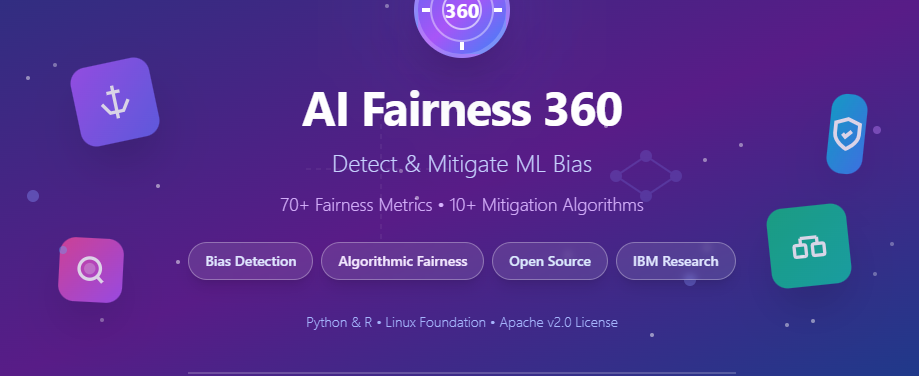
AI Fairness 360 (AIF360) addresses this challenge head-on. Developed by IBM Research and now maintained by the Linux Foundation, this comprehensive open-source toolkit provides over 70 fairness metrics and 10+ state-of-the-art algorithms to detect and mitigate bias throughout the entire machine learning lifecycle.
What is AI Fairness 360?
AI Fairness 360 is an extensible Python and R toolkit designed to help researchers, developers, and practitioners examine, report, and mitigate discrimination and bias in machine learning models. Unlike general-purpose machine learning libraries, AIF360 focuses specifically on fairness, providing specialized tools for each stage of the AI application lifecycle.
The toolkit’s primary objectives are twofold. First, it aims to facilitate the transition of fairness research algorithms from academic labs into practical industrial applications. Second, it provides a common framework enabling fairness researchers to share, evaluate, and compare different approaches systematically.
Originally created by IBM Research in 2018 and transferred to the Linux Foundation AI & Data in July 2020, AIF360 has become the most widely adopted toolkit for AI fairness assessment. It’s designed to translate algorithmic fairness research into practice across domains as wide-ranging as finance, human capital management, healthcare, and education.
Why AI Fairness 360 Matters for Academic Research
The Bias Problem in Machine Learning
Machine learning, by its very nature, involves statistical discrimination—making predictions based on patterns in data. This discrimination becomes objectionable when it systematically advantages privileged groups whilst disadvantaging unprivileged ones.
Bias in machine learning stems from multiple sources. Training data may reflect historical prejudice in labeling decisions. Datasets may over-sample or under-sample certain populations. Features used for prediction may correlate with protected attributes like race, gender, or age. Even well-intentioned algorithmic choices can inadvertently amplify existing inequalities.
For academics researching AI ethics, fairness, and responsible AI deployment, understanding and mitigating these biases is fundamental. AIF360 provides the rigorous tools necessary for this research.
Academic Applications Across Disciplines
Computer Science and AI Research: Researchers developing new fairness algorithms, comparing mitigation approaches, and advancing the theoretical understanding of algorithmic fairness use AIF360 as their standard evaluation framework.
Social Sciences: Sociologists, psychologists, and economists studying the societal impacts of algorithmic decision-making leverage AIF360 to quantify bias in real-world systems and evaluate intervention effectiveness.
Law and Policy: Legal scholars and policymakers analyzing regulatory frameworks like the EU AI Act, GDPR’s “Right to Explanation,” and employment discrimination law use AIF360 to assess compliance and develop evidence-based policy recommendations.
Healthcare Research: Medical researchers examining bias in clinical decision support systems, diagnostic algorithms, and resource allocation models employ AIF360 to ensure equitable healthcare delivery.
Business and Management: Researchers studying fair hiring practices, equitable lending, and ethical business operations use the toolkit to develop and evaluate bias-free organizational systems.
Core Features and Capabilities
Comprehensive Fairness Metrics (70+)
AIF360 provides an extensive collection of fairness metrics that quantify different aspects of bias:
Group Fairness Metrics compare statistical measures between subpopulations divided by protected attributes. These include:
- Statistical Parity Difference: Measures whether different groups receive positive outcomes at equal rates
- Disparate Impact: Examines whether the ratio of positive outcome rates between unprivileged and privileged groups meets legal thresholds (typically 0.8)
- Equal Opportunity Difference: Assesses whether true positive rates are equal across groups
- Average Odds Difference: Evaluates differences in both false positive and true positive rates
- Theil Index: Measures inequality in benefit allocation across groups
Individual Fairness Metrics evaluate whether similar individuals receive similar treatment, regardless of group membership. These require defining similarity functions or distance matrices between individuals.
Bias Mitigation Algorithms (10+)
AIF360 includes state-of-the-art algorithms organized by when they intervene in the machine learning pipeline:
Pre-processing Algorithms act on training data before model development:
- Reweighing: Adjusts the weights of different training examples to ensure fair representation
- Optimized Preprocessing: Transforms features and labels to achieve better fairness-accuracy trade-offs
- Learning Fair Representations: Learns data representations that obscure information about protected attributes whilst maintaining predictive power
- Disparate Impact Remover: Edits feature values to improve group fairness
- FairAdapt: Performs causal inference-based preprocessing
In-processing Algorithms integrate fairness constraints during model training:
- Adversarial Debiasing: Uses adversarial techniques to maximize accuracy whilst minimizing evidence of protected attributes in predictions
- Prejudice Remover: Adds discrimination-aware regularization to the learning objective
- Meta Fair Classifier: Incorporates fairness constraints directly into the classifier
- Gerry Fair Classifier: Addresses rich subgroup fairness
Post-processing Algorithms adjust model predictions to improve fairness:
- Calibrated Equalized Odds: Optimizes over calibrated classifier scores that lead to fair output labels
- Reject Option Classification: Changes predictions near the decision boundary to reduce discrimination
- Equalized Odds Postprocessing: Adjusts predictions to satisfy the equalized odds fairness criterion
Dataset Handling and Structure
AIF360 provides specialized dataset classes for handling data with protected attributes:
- BinaryLabelDataset: For binary classification tasks with explicit protected attribute handling
- StandardDataset: For general-purpose fairness analysis with flexible attribute specification
- Compatibility with scikit-learn pipelines and workflows
- Built-in datasets including Adult Income, COMPAS, German Credit, and Medical Expenditure Panel Survey data
Interactive Web Experience
Beyond the Python and R packages, AIF360 includes an interactive web demonstration that provides a gentle introduction to fairness concepts for line-of-business users, students, and researchers new to the field. This educational tool helps users understand different fairness definitions, see metrics in action, and explore mitigation approaches without writing code.
Getting Started with AI Fairness 360
Installation
Installing AIF360 is straightforward via pip:
pip install aif360For specific algorithms with additional dependencies:
pip install 'aif360[AdversarialDebiasing,LFR]'Or install all optional dependencies:
pip install 'aif360[all]'For R users, the package is available via CRAN:
install.packages("aif360")Basic Workflow Example
A typical AIF360 workflow follows this pattern:
- Load and prepare data with protected attributes explicitly defined
- Compute baseline fairness metrics on the original dataset
- Apply bias mitigation using pre-processing, in-processing, or post-processing techniques
- Train a model on the transformed data
- Evaluate fairness and accuracy on predictions
- Compare metrics before and after mitigation
This systematic approach ensures reproducibility and allows researchers to quantify the effectiveness of different mitigation strategies.
Choosing the Right Approach
With over 70 metrics and 10+ algorithms, selecting the appropriate tools can be challenging. AIF360 provides guidance materials to help:
- Consider your fairness definition—different metrics operationalize fairness differently
- Assess whether you can modify training data (pre-processing), training procedure (in-processing), or only outputs (post-processing)
- Evaluate acceptable fairness-accuracy trade-offs for your application
- Consult domain-specific regulations and legal requirements
Practical Applications and Case Studies
Credit Scoring and Lending
AIF360’s German Credit dataset tutorial demonstrates detecting and mitigating age bias in creditworthiness predictions. This application is particularly relevant given regulatory requirements like the Equal Credit Opportunity Act and fair lending laws worldwide.
Researchers have shown that applying reweighing to credit datasets can reduce selection-rate disparities by 10-20 percentage points whilst maintaining strong predictive accuracy. The toolkit enables transparent auditing of lending algorithms to ensure compliance with anti-discrimination laws.
Healthcare and Medical Decision-Making
The Medical Expenditure Panel Survey tutorial illustrates mitigating racial bias in care management scenarios. Healthcare applications are especially sensitive because biased algorithms can perpetuate healthcare disparities, denying necessary care to vulnerable populations.
Studies using AIF360 have identified significant racial disparities in clinical risk prediction scores and demonstrated that mitigation techniques can improve equity without substantially reducing predictive performance. This research informs evidence-based policy on algorithm use in healthcare settings.
Criminal Justice and Recidivism Prediction
The COMPAS recidivism dataset has become a canonical example in algorithmic fairness research following ProPublica’s investigation revealing racial bias in predictions. AIF360 provides tools to replicate these analyses, evaluate different fairness criteria, and develop fairer alternatives.
Researchers examining recidivism prediction have found that no single mitigation approach satisfies all fairness definitions simultaneously—a finding that highlights the importance of thoughtful, context-specific fairness criterion selection.
Employment and Hiring
HR researchers use AIF360 to audit hiring algorithms for discrimination based on protected characteristics. Studies implementing prototype auditing dashboards with AIF360 have found that fair-reranked candidate shortlists receive higher perceived equity ratings from human evaluators.
This research demonstrates that fairness interventions can improve both objective metrics and subjective perceptions of fairness amongst stakeholders.
Understanding Fairness-Accuracy Trade-offs
A recurring finding in fairness research is the fairness-accuracy trade-off: efforts to improve group fairness often result in modest reductions in overall model accuracy. Typical patterns include:
- Improving group fairness by 10-15% often reduces overall accuracy by 2-5%
- Pre-processing methods generally have smaller accuracy impacts than post-processing
- The severity of trade-offs depends heavily on the dataset, problem, and fairness criterion
For academics, AIF360 enables systematic study of these trade-offs, helping identify contexts where fairness and accuracy align and situations where they conflict. This research informs practical decisions about when fairness interventions are feasible and how to optimize for both objectives.
Integration with Machine Learning Workflows
Scikit-learn Compatibility
AIF360 estimators inherit from scikit-learn Estimators and work within scikit-learn pipelines:
This compatibility allows seamless integration with existing machine learning workflows.
Jupyter Notebooks and Tutorials
AIF360’s GitHub repository includes extensive Jupyter notebook tutorials demonstrating:
- Credit scoring fairness analysis
- Medical expenditure prediction bias mitigation
- Face image gender classification
- COMPAS recidivism prediction auditing
- Custom metric and algorithm development
These notebooks provide working code examples that researchers can adapt to their own datasets and applications.
Limitations and Considerations
The Impossibility of Perfect Fairness
Fairness researchers have proven that satisfying all fairness definitions simultaneously is mathematically impossible in most real-world scenarios. Different fairness criteria can conflict, requiring careful selection of which definition best aligns with ethical values and legal requirements for a given context.
AIF360 helps researchers navigate these challenges by making trade-offs explicit and quantifiable, but it cannot resolve fundamental tensions between competing fairness notions.
Fairness-Accuracy Trade-offs
Whilst many applications achieve meaningful fairness improvements with minimal accuracy loss, some contexts may face more substantial trade-offs. Researchers must evaluate whether these trade-offs are acceptable given the stakes involved.
Data Requirements
Effective fairness analysis requires datasets with explicitly labeled protected attributes. In contexts where collecting such data is prohibited or where protected attributes must be inferred, AIF360’s capabilities are more limited.
Beyond Individual Bias Mitigation
AIF360 focuses on statistical bias in machine learning models, but systemic fairness requires addressing broader issues: data collection practices, problem formulation, stakeholder participation, and ongoing monitoring. The toolkit is a powerful component of responsible AI development but not a complete solution on its own.
Computational Requirements
Some algorithms, particularly adversarial debiasing, require significant computational resources. Researchers working with large datasets may need to consider runtime and resource constraints.
Contributing to AIF360
The open-source nature of AIF360 encourages community contribution. Researchers can:
- Add new fairness metrics based on their research
- Contribute bias mitigation algorithms they’ve developed
- Share Jupyter notebooks demonstrating novel applications
- Provide feedback and bug reports through GitHub
- Participate in the Slack community to discuss implementation challenges
The toolkit’s extensible architecture makes adding new functionality straightforward, and the maintainers actively welcome contributions that advance the field.
The Future of Fairness Research
As AI systems become more pervasive in consequential decision-making, fairness research will become increasingly critical. Key directions include:
Causal Fairness: Moving beyond correlation-based fairness metrics to causal frameworks that distinguish legitimate from illegitimate sources of disparity.
Intersectional Fairness: Developing methods that address fairness for individuals with multiple marginalized identities, not just single protected attributes.
Dynamic Fairness: Creating approaches for fairness in sequential decision-making and reinforcement learning contexts.
Explainable Fairness: Combining fairness with explainability to help stakeholders understand both what models predict and whether predictions are fair.
Regulatory Compliance: Developing tools and frameworks aligned with emerging regulations like the EU AI Act, which requires fairness assessments for high-risk AI systems.
AIF360 provides the foundational infrastructure for this research, enabling rigorous, reproducible evaluation of new approaches.
Conclusion
AI Fairness 360 represents a significant milestone in the translation of fairness research from academic theory to practical implementation. By providing comprehensive metrics, state-of-the-art algorithms, and accessible documentation, the toolkit empowers researchers and practitioners to build more equitable AI systems.
For academics, AIF360 offers the rigorous tools necessary to advance fairness research, whether developing new theoretical approaches, conducting empirical studies of bias in real-world systems, or evaluating policy interventions. Its open-source nature and active community ensure it will continue evolving alongside the field.
As algorithmic decision-making becomes ubiquitous, tools like AIF360 are essential infrastructure for ensuring AI systems serve all of humanity equitably. Whether you’re a computer scientist researching novel fairness algorithms, a social scientist studying AI’s societal impacts, or a student learning about responsible AI development, AI Fairness 360 deserves a central place in your toolkit.
Explore more AI ethics and responsible AI tools: Learn about other fairness tools, discover Elicit for literature reviews, or browse our complete directory of AI tools for academics.
Frequently Asked Questions
Is AI Fairness 360 free to use?
Yes, AI Fairness 360 is completely free and open-source, released under an Apache v2.0 license. It’s available for anyone to use, modify, and extend for research, educational, or commercial purposes. The toolkit is maintained by the Linux Foundation AI & Data with contributions from the global research community.
What programming languages does AI Fairness 360 support?
AI Fairness 360 is available in both Python and R. The Python package offers the most comprehensive feature set and active development. The R package provides core functionality for R users, though some advanced features may be Python-exclusive. Both packages can be installed via standard package managers (pip and CRAN respectively).
Can I use AI Fairness 360 with my existing machine learning workflows?
Yes, AIF360 is designed for integration with standard machine learning workflows. The Python toolkit includes scikit-learn-compatible estimators that work within scikit-learn pipelines. Datasets can be converted between AIF360 formats and standard data structures like Pandas DataFrames and NumPy arrays, enabling use alongside other machine learning libraries.
What fairness metrics should I use for my research?
The appropriate metrics depend on your context and which fairness definition aligns with your ethical values and legal requirements. Group fairness metrics like statistical parity and disparate impact are common for demographic fairness. Individual fairness metrics evaluate whether similar individuals receive similar treatment. AIF360’s guidance materials and interactive experience help researchers understand different metrics and select appropriate ones for their applications.
How do I handle multiple protected attributes (intersectionality)?
AIF360 supports analysis with multiple protected attributes defined simultaneously. However, standard metrics typically examine each attribute independently rather than considering intersectional identities (e.g., Black women as distinct from Black people generally and women generally). Researchers studying intersectional fairness may need to create custom attribute combinations or use more advanced approaches beyond standard metrics.
What’s the trade-off between fairness and accuracy?
Research using AIF360 consistently finds that improving group fairness by 10-15% typically reduces overall model accuracy by 2-5%, though this varies by dataset, model, and fairness criterion. Pre-processing methods generally have smaller accuracy impacts than post-processing approaches. The toolkit enables systematic study of these trade-offs, helping researchers identify optimal balance points for their specific applications.
Can AI Fairness 360 guarantee my model is fair?
No tool can “guarantee” fairness because fairness is a complex ethical concept with competing definitions that are sometimes mutually exclusive. AIF360 provides rigorous quantitative assessment of different fairness criteria and tools to improve fairness along those dimensions, but human judgment remains essential for determining which fairness definitions matter most and whether trade-offs are acceptable.
How do I get started with AI Fairness 360 as a beginner?
Start with the interactive web experience to understand fairness concepts without coding. Then install the Python package and work through the provided Jupyter notebook tutorials using built-in datasets like German Credit or COMPAS. These tutorials walk through complete workflows from data loading through bias mitigation. The comprehensive documentation and active Slack community provide support for questions.
Does AI Fairness 360 work with deep learning models?
Yes, AIF360 includes algorithms specifically designed for deep learning, such as Adversarial Debiasing which uses neural networks. The metrics can evaluate any model type—traditional machine learning, deep learning, or ensemble methods. However, some pre-processing and in-processing techniques are designed for specific model types, so algorithm selection depends on your modeling approach.
Can I contribute my own fairness metrics or algorithms?
Absolutely! AIF360 is designed for extensibility and welcomes community contributions. The GitHub repository includes documentation on how to add new metrics and algorithms. Researchers who’ve developed novel fairness approaches are encouraged to contribute them to AIF360, making their work accessible to the broader community and establishing it as a benchmark for comparison.
Leave a Reply